
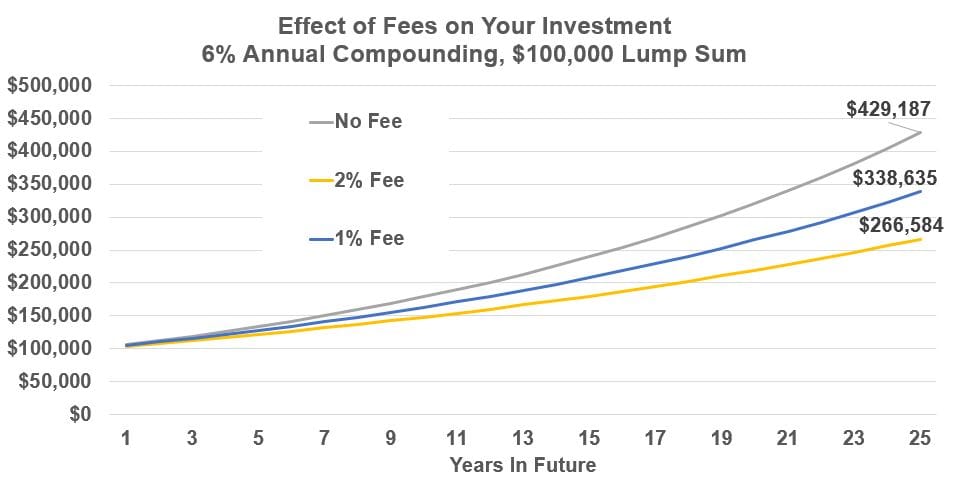
Fees compounded over decades
The Silent Killer: How Fees Compound Over Decades
Picture two school friends from Birmingham, both born in 1955. At age 30, in 1985, they each inherited £50,000. Both decided to invest in the UK stock market for their retirement. The first, let’s call him David, walked into a high-street bank and was sold a managed unit trust with a 5% initial charge and an annual management fee of 1.5%. The second, Sarah, was naturally sceptical and sought out a low-cost index tracker, paying no upfront fee and just 0.2% annually. They both achieved the same gross market return of 10% annually. Today, David has just over £1.1 million. Sarah sits on £2.1 million. The silent killer of compound fees didn’t just nibble at the edges; it devoured nearly half of David’s potential wealth. We are here to expose exactly how this arithmetic massacre works and how you can stop it from happening to your family.
The Arithmetic of Erosion: It’s Not What You Pay, It’s What You Don’t Compound
When we talk about investment fees, the numbers often sound politely small—1%, 1.5%, maybe 2%. Our brains, wired for linear thinking, dismiss these as the cost of a decent coffee. But markets are not linear; they are exponential. A fee is not a one-off extraction; it is a permanent removal of the capital you need to fuel future growth. We are dealing with an arithmetic tragedy where the sum of the parts lost vastly exceeds the visible deductions.
The Pre-RDR Wild West: When 5% Entry Fees Were Normal
To truly understand the trauma embedded in UK retail finance, we must revisit the dark ages before the Retail Distribution Review (RDR) of 2012. In that era, the “bid-offer spread” on a standard UK unit trust was a brutal mechanism. Investors didn’t just pay an annual fee; they were immediately 5% underwater the moment they invested. If you handed over £10,000, only £9,500 actually hit the market. That missing £500 had to be earned back just to break even. We remember this period not with nostalgia, but with a shudder. It was a structural machine designed to extract wealth from the uninformed, making it mathematically impossible for the average saver to get ahead without a multi-year bull run simply to cover the entry tax.
A 1% Fee Isn’t 1%: Visualising the 30-Year Drag
Let’s dismantle the most dangerous lie in finance: “It’s only 1%.” Imagine a £100,000 portfolio growing at a steady 7% annually. Over 30 years, with zero fees, this compounds to approximately £761,000. Introduce a seemingly modest 1% annual fee, reducing your net return to 6%, and the final pot shrinks to roughly £574,000. That is a £187,000 shortfall. The fee wasn’t 1% of the final pot; it was nearly 25% of your total future wealth. We see this as a compounding betrayal. The manager took a quarter of your retirement while you took 100% of the risk. This is the cold, hard reality of the fee drag that glossy brochures never illustrate.
Lessons from the South Sea Bubble: Fee Friction in Mania
Financial history is a loop, not a straight line. Long before the RDR or complex platform fees, there was Exchange Alley in 1720. The South Sea Bubble is often taught as a story of greed, but we view it as a masterclass in the destructive power of intermediation costs. The mania was fuelled by middlemen extracting crippling commissions, proving that friction is the enemy of the speculator and the saver alike.
Newton’s Fatal Trade: Genius Overwhelmed by Friction
Sir Isaac Newton was arguably the most brilliant scientific mind in history, yet he was utterly defeated by the market. He correctly identified the South Sea scheme as a bubble early on, selling his shares for a tidy 100% profit. But as euphoria gripped London, he bought back in near the top. What is less discussed is the friction. The high “stock jobbing” commissions and transfer fees of the era acted exactly like modern fund charges. When the stock collapsed, Newton lost £20,000—a fortune in modern terms. We see his loss not as stupidity, but as a psychological failure amplified by transaction costs. The friction made it harder to get out cleanly, and the churn enriched the brokers while destroying the physicist. He famously lamented he could “calculate the motions of the heavenly bodies, but not the madness of the people,” but we’d argue he failed to calculate the deadly arithmetic of the middleman’s cut.
The Vanguard Revolution and the UK’s Slow Awakening
Across the Atlantic, a stubborn man named Jack Bogle looked at the same maths we just examined and declared war. His idea was so simple it was dismissed as “Bogle’s Folly.” He argued that instead of trying to beat the market, you should simply own it at the lowest possible cost. The UK, comfortably insulated by a commission-hungry establishment, took decades to catch on. But when the dam broke, it swept away the old guard.
Bogle’s Folly: How a ‘Boring’ Idea Crushed Active Management
Bogle’s insight was brutal: gross returns minus costs equals net returns. By simply minimising the “costs” variable, a passive fund would beat the majority of active managers over the long term simply because the active managers were charging too much. We watched this play out in slow motion. For years, UK active managers mocked trackers as a guarantee of mediocrity. They were wrong. The compounding of their own fees guaranteed their underperformance. The boring idea didn’t just crush active management; it democratised wealth creation, proving that in investing, excitement is often a tax on the naive.
The Consumer Duty Tipping Point in the UK
While Bogle lit the intellectual fire, regulation provided the legal hammer in the UK. The RDR in 2012 banned commission payments to advisors, killing the 5% initial charge overnight. But the final nail in the coffin for opaque pricing arrived with the Consumer Duty regulation in 2023. This wasn’t just a guideline; it was a mandate requiring firms like Hargreaves Lansdown and St. James’s Place to prove they deliver “fair value.” We see this as the regulatory tipping point. Suddenly, the ornate wealth management offices had to justify their fees not by the plushness of their carpets, but by hard outcomes. St. James’s Place, long known for its high early exit charges, was forced into a radical overhaul of its charging structure. The law finally caught up with the arithmetic.
Investor Psychology: Why We Blindly Pay for Complexity
If the maths is so clear, why do intelligent people still hand over 1.5% annually for underperformance? The answer lies not in the spreadsheet, but in the brain. We are hardwired to equate price with quality, especially when we are scared. The financial industry has masterfully exploited this evolutionary glitch for centuries.
The Gilded Hall Effect: Trusting Oak Panels Over Spreadsheets
There is a reason why legacy wealth managers in the City of London keep the oak panels polished and the art expensive. We call this the “Gilded Hall Effect.” When we hand our life savings over to someone in a glass tower furnished with mahogany, our lizard brain feels safe. A simple FTSE 250 tracker, bought via an app on your phone, feels dangerous precisely because it is cheap and accessible. We instinctively mistrust the lack of friction. This is a catastrophic psychological error. The oak panels are paid for by your compound returns. The spreadsheet is free. We must re-train our brains to see high costs not as a badge of safety, but as a warning sign of extraction.
Loss Aversion and the ‘Safety’ of Expensive Active Funds
During a market crash, our instinct is to run to a “professional” who promises to protect us. Active fund managers sell the dream of downside protection. The data, however, shows that the vast majority fail to provide it. Yet, loss aversion—our tendency to feel the pain of a loss twice as strongly as the joy of a gain—drives us into their arms. We pay the 1.5% fee as an emotional insurance premium, even though the policy almost never pays out. We are terrified of losing money in the market, but we ignore the guaranteed, silent loss inflicted by the fees themselves.
The Dividend Reinvestment Multiplier: Where Fees Bite Deepest
Most investors focus on the price chart, but the real magic of UK equities lies in dividends. The FTSE 100 has historically offered juicy yields. The true crime of high fees is not just skimming the capital growth, but strangling the compounding power of those reinvested dividends over half a century.
The Shell Shock: A 50-Year Dividend Reinvestment Simulation
Let’s look at a UK dividend aristocrat, Shell. Imagine a £10,000 investment in 1974, with all dividends reinvested. Over 50 years, the gross return, including those rolling dividends, is staggering, turning the initial stake into millions. Now, apply a total cost ratio (TER) of 2%—common in older insurance-based funds—versus a low-cost vehicle at 0.25%. The difference isn’t thousands; it is hundreds of thousands of pounds. The high-fee environment didn’t just take a slice of the oil profits; it stole the shares that the dividends would have bought. We call this the “double theft.” You lose the dividend cash, and you lose all the future growth that cash would have generated. It is the most silent and devastating aspect of long-term wealth erosion.
How to Diagnose and Cure Fee Cancer in Your Own Portfolio
This diagnosis sounds grim, but the cure is simple, fast, and entirely within your control. You do not need to pick the next Nvidia to retire rich. You simply need to stop the bleeding. A portfolio autopsy is not a complex financial exercise; it is an act of self-preservation.
The One-Hour Portfolio Autopsy
We urge you to set aside sixty minutes this week. Log into your investment platform—be it Hargreaves Lansdown, AJ Bell, or Interactive Investor—and pull up your total charges. You need to find three numbers:
- The Ongoing Charges Figure (OCF/TER): This is the internal fund fee. If it starts with a ‘1’, you are likely paying too much.
- Platform Fee: Often a percentage of your assets. This compounds just as aggressively as the fund fee.
- Transaction Costs: The hidden dealing spreads inside the fund. While harder to find, the FCA now forces disclosure.
Add these three numbers together. If your total cost of ownership exceeds 0.75%, you have found the cancer. Switching to a globally diversified passive ETF with a TER of 0.12% on a capped-fee platform is an afternoon’s work that will literally buy you a house in retirement.
Negotiating Hard on Platform Fees: Yes, You Can
In the UK, we are culturally averse to haggling over finance, but this is a business transaction. If you have a six-figure portfolio, you have leverage. Platforms charge percentage fees, meaning they earn more from you as you grow wealthier. Call them. Tell them you are considering moving to a flat-fee competitor. We have seen platform fees waived or reduced, especially in the current climate of Consumer Duty. The worst they can say is no. The best case is an instant, permanent boost to your net returns. You are not being rude; you are being rational.
Financial literacy is often sold as the ability to predict the next market crash or pick the next hot stock. We see it differently. True literacy is understanding the silent, relentless mathematics of costs. It is recognising that the South Sea Bubble brokers and the modern high-fee fund manager are driven by the same incentive. By cutting out the middleman, ignoring the oak panels, and owning the market at the lowest possible cost, you don’t just beat the professionals—you let the eighth wonder of the world, compound interest, work exclusively for you.
Frequently Asked Questions
What exactly was the Retail Distribution Review (RDR)?
The Retail Distribution Review (RDR) came into force in the UK on 31 December 2012. It fundamentally banned financial advisors from taking commission from fund providers for recommending their products. Before RDR, an advisor could put you in a fund with a 5% initial charge and pocket that commission, often without you explicitly realising the conflict of interest. RDR forced advisors to agree on an upfront, transparent fee with clients, effectively killing the “free advice” model that was secretly very expensive.
Why is St. James’s Place often mentioned in discussions about high fees?
St. James’s Place (SJP) has historically been one of the UK’s largest wealth management firms, but its charging structure has faced intense criticism. SJP typically charged an upfront advice fee, an ongoing annual management charge, and crucially, early exit penalties if clients tried to withdraw their money within the first few years. Under the pressure of the new Consumer Duty regulation, SJP announced sweeping changes in 2023, scrapping these exit fees entirely to prove they offer fair value to clients.
Is a 1% annual fee really that harmful over the long term?
Yes, it is catastrophic. Because of compounding, a 1% fee does not equal a 1% loss of final capital. Over a 40-year working life, a 1% annual fee can consume roughly 25% to 30% of your total potential retirement pot. For example, a portfolio that would have grown to £1 million without fees might only reach £700,000 with a 1% fee. The manager took £300,000 of your future wealth without taking any of the market risk.
How did the South Sea Bubble relate to modern investment fees?
The South Sea Bubble of 1720 was inflated by rampant speculation, but it was heavily greased by middlemen taking large commissions and fees for trading shares. Sir Isaac Newton famously lost a fortune, not just because the price collapsed, but because the high transaction costs of the time eroded his capital. This mirrors modern investing, where high fund fees and trading costs act as a constant “friction,” making it mathematically harder for investors to compound their wealth successfully, much like Newton’s era.
What does the Consumer Duty regulation mean for my investments?
Introduced by the Financial Conduct Authority (FCA) on 31 July 2023, the Consumer Duty is a major shift in UK regulation. It requires financial firms, including platforms like Hargreaves Lansdown and fund managers, to prove they are delivering “fair value.” They can no longer hide behind complex small print. Firms must now actively assess whether their charges are reasonable compared to the service provided, giving you a much stronger footing to challenge and query high fees on your existing portfolio.